Every spring morning brings a symphony of colors to our backyards, but few sights captivate birdwatchers quite like the flash of brilliant red feathers catching the early sunlight. Did you know that over 40 species of predominantly red birds can be observed across North America alone? From the iconic Northern Cardinal’s year-round crimson presence to the Summer Tanager’s seasonal scarlet display, red birds represent some of our continent’s most sought-after avian treasures.
Yet here lies the challenge that frustrates both novice and experienced birders: distinguishing between remarkably similar red species in the field. How many times have you spotted a vibrant red bird, only to struggle with whether you’re observing a male House Finch, a Purple Finch, or perhaps a Cassin’s Finch? The subtle differences in bill shape, wing bars, and behavioral patterns can make definitive identification feel like solving a complex puzzle with constantly moving pieces.
In this comprehensive guide, you’ll master the art of red bird identification through proven field techniques, detailed species profiles, and expert insights that transform confusing sightings into confident identifications. By understanding the key distinguishing features, seasonal variations, and behavioral clues that separate each species, you’ll never again wonder about that stunning red visitor at your feeder or the crimson flash in your local woodland.
Understanding Red Plumage in Birds
Red coloration in birds stems primarily from carotenoid pigments obtained through diet, making it one of nature’s most honest signals of health and genetic fitness. Unlike melanin-based colors that birds produce internally, red hues require continuous dietary intake of carotenoid-rich foods like berries, seeds, and insects.
This biological reality explains several critical identification factors. Male birds typically display more vibrant reds during breeding season when testosterone levels peak and nutritional resources are abundant. Females often show muted red tones or completely different coloration patterns, serving as crucial field marks for species identification.
Seasonal Variations in Red Intensity
Environmental factors significantly impact red plumage intensity throughout the year:
- Breeding season (spring/summer): Peak red coloration in males
- Molting period (late summer): Temporarily duller appearance
- Winter months: Reduced intensity due to limited carotenoid sources
- Geographic location: Regional diet variations affect color saturation
Understanding these temporal changes prevents misidentification during transitional periods when familiar species may appear dramatically different.
Essential Field Marks for Red Bird Identification
Successful red bird identification requires systematic observation of multiple distinguishing characteristics beyond color alone. Professional ornithologists rely on a hierarchy of field marks, starting with the most reliable features that remain consistent across seasons and age groups.
Primary Identification Features
Bill Shape and Size: Red bird species have evolved specialized bill shapes reflecting their dietary preferences. Seed-eating finches possess thick, conical bills perfect for cracking tough hulls. Insectivorous tanagers display thinner, more pointed bills designed for capturing insects. Cardinals showcase massive, powerful bills capable of crushing the largest seeds.
Body Proportions and Size: Size relationships provide immediate identification clues. House Finches measure 5-6 inches with compact builds, while Scarlet Tanagers reach 6-7 inches with more elongated proportions. Northern Cardinals, at 8-9 inches, dominate most mixed feeding flocks.
Wing and Tail Patterns: Wing bars, patches, and tail markings remain consistent identification features regardless of seasonal plumage changes. Red-winged Blackbirds display distinctive shoulder patches, while many finch species show characteristic wing bar patterns.
Behavioral Identification Clues
Feeding Behavior: Each red bird species exhibits unique feeding patterns that aid field identification:
- Ground feeding: Towhees and some sparrows
- Acrobatic hanging: House Finches and Purple Finches
- Methodical branch searching: Tanagers hunting insects
- Aggressive feeder domination: Cardinals establishing hierarchy
Flight Patterns: Distinct flight characteristics help identify distant birds:
- Undulating flight: Most finch species
- Direct, powerful flight: Cardinals and grosbeaks
- Erratic, butterfly-like flight: Redpolls and siskins
Complete Guide to North American Red Birds
Cardinals and Pyrrhuloxia
Northern Cardinal (Cardinalis cardinalis)
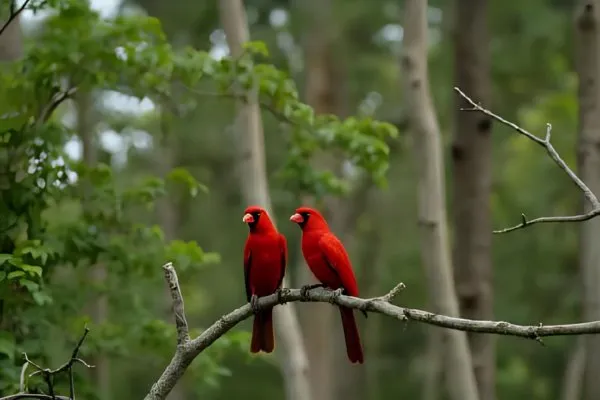
The Northern Cardinal serves as the benchmark for red bird identification across eastern North America. Males display uniform crimson-red plumage with a distinctive black face mask extending around the eyes and bill base. Their massive, orange-red bill can crack the toughest sunflower seeds with ease.
Key Field Marks:
- Prominent pointed crest
- Thick, conical orange-red bill
- Black face mask in males
- Females: warm brown with red tinges on wings, tail, and crest
Habitat and Range: Woodlands, parks, suburban gardens from southeastern Canada through Central America.
Pyrrhuloxia (Cardinalis sinuatus)
Often called the “Desert Cardinal,” the Pyrrhuloxia represents the southwestern counterpart to its eastern cousin. Males show gray-brown plumage with bright red accents on face, breast, and crest, creating a more subdued but equally striking appearance.
Distinguishing Features:
- Curved, yellow-orange bill (vs. straight cardinal bill)
- Gray-brown base color with red highlights
- Longer, more pointed crest
- Limited to arid southwestern regions
Tanagers and Grosbeaks
Scarlet Tanager (Piranga olivacea)
Male Scarlet Tanagers during breeding season represent one of North America’s most spectacular red birds. Their brilliant scarlet-red body contrasted with jet-black wings and tail creates an unmistakable field identification. This dramatic coloration transforms completely during fall migration when males molt into olive-yellow plumage resembling females.
Critical Identification Points:
- Solid red body with black wings (breeding males)
- Pale yellow-green bill
- No crest or head markings
- Insectivorous behavior in tree canopies
Summer Tanager (Piranga rubra)
The Summer Tanager provides a more uniform red appearance compared to its scarlet cousin. Males display rose-red coloration throughout body, wings, and tail without contrasting black markings. Their specialized diet includes wasps and bees, often caught in spectacular aerial displays.
Field Recognition Features:
- Uniform rose-red coloration (no black)
- Slightly larger and stockier than Scarlet Tanager
- Light-colored, somewhat swollen bill
- Prefers oak-pine woodlands
Rose-breasted Grosbeak (Pheucticus ludovicianus)
Male Rose-breasted Grosbeaks combine black and white plumage with striking red breast patches. The triangular red patch on the white breast serves as the most reliable field mark, complemented by massive pale bills and bold wing patches.
Identifying Characteristics:
- Black head and back with white rump
- Triangular red breast patch
- White wing patches visible in flight
- Enormous pale pink bill
Red Finches and Siskins
House Finch (Haemorhous mexicanus)
House Finches represent the most commonly observed red birds at backyard feeders across North America. Males show variable red coloration ranging from bright red to orange or yellow, typically concentrated on head, breast, and rump while maintaining brown-streaked backs and flanks.
Essential Field Marks:
- Red limited to head, breast, and rump
- Brown streaked back and flanks
- Slightly curved bill
- Square-notched tail
- Gregarious feeding behavior
Purple Finch (Haemorhous purpureus)
Despite the misleading name, male Purple Finches display raspberry-red coloration that extends more extensively than House Finches. The red wash covers head, breast, back, and rump, creating a more uniform appearance often described as “dipped in raspberry juice.”
Distinguishing Features:
- More extensive red coverage than House Finch
- Unstreaked or lightly streaked flanks
- Slightly larger and stockier build
- Forked tail
- More pointed bill
Cassin’s Finch (Haemorhous cassinii)
Cassin’s Finch occupies mountainous regions of western North America, showing characteristics intermediate between House and Purple Finches. Males display bright red crown and pink-red breast with distinct separation between red and brown areas.
Key Identification Points:
- Bright red crown contrasting with brown nape
- Pink-red breast without extensive back coloration
- Longest bill of the three red finch species
- White wing bars more prominent than relatives
- High elevation coniferous forest habitat
Red-winged Species
Red-winged Blackbird (Agelaius phoeniceus)
While primarily black, male Red-winged Blackbirds feature brilliant red shoulder patches bordered with yellow that qualify them for red bird consideration. These conspicuous patches serve territorial and courtship functions, often concealed when perched but flashed prominently during displays.
Field Identification:
- Glossy black plumage overall
- Bright red shoulder patches (epaulets)
- Yellow border on red patches
- Females: heavily streaked brown
- Marshland habitat preference
Red Crossbill (Loxia curvirostra)
Red Crossbills showcase specialized bills with crossed mandible tips adapted for extracting seeds from conifer cones. Males display brick-red to orange-red plumage with darker wings and tail, representing one of the most unique red birds in North American forests.
Specialized Features:
- Distinctive crossed bill tips
- Brick-red to orange body color
- Dark wings contrasting with red body
- Nomadic movement patterns following cone crops
- Acrobatic feeding behavior on conifer branches
Advanced Identification Techniques
Utilizing Vocalizations for Species Recognition
Cardinal Species Vocalizations: Northern Cardinals produce clear, whistled phrases often described as “birdy-birdy-birdy” or “cheer-cheer-cheer.” Their calls include sharp “chip” notes and metallic “pink” sounds. Pyrrhuloxias offer similar but slightly harsher vocalizations with more nasal qualities.
Tanager Species Songs: Scarlet Tanagers deliver robin-like songs with a distinctive hoarse quality, often described as “a robin with a sore throat.” Summer Tanagers produce similar phrases but with clearer, more melodious tones. Both species use characteristic “chip-burr” call notes.
Finch Family Vocalizations: House Finches create varied, warbling songs incorporating both musical notes and harsh elements. Purple Finches produce richer, more musical warbling without harsh components. Cassin’s Finches offer complex, melodious songs often given from prominent perches.
Habitat Preferences and Ecological Niches
Understanding habitat requirements dramatically improves identification success and locating target species.
Forest Canopy Species: Tanagers prefer mature deciduous or mixed forests, typically remaining in upper canopy levels. Scarlet Tanagers favor oak-hickory forests, while Summer Tanagers select oak-pine associations.
Edge and Woodland Species: Cardinals thrive in woodland edges, parks, and suburban environments with dense shrub layers. Rose-breasted Grosbeaks prefer deciduous forest edges with adequate understory development.
Open Woodland and Scrub: House Finches adapt to various habitats including urban environments, agricultural areas, and open woodlands. Purple Finches favor coniferous and mixed forests with adequate seed sources.
Specialized Habitats: Red Crossbills require mature coniferous forests with abundant cone production. Red-winged Blackbirds depend on wetland environments with emergent vegetation.
Seasonal Migration Patterns
Permanent Residents: Northern Cardinals, House Finches, and Pyrrhuloxias maintain year-round territories in suitable habitat, providing consistent observation opportunities.
Short-distance Migrants: Purple Finches and Red Crossbills exhibit irregular movement patterns following food availability rather than strict seasonal schedules.
Long-distance Migrants: Scarlet Tanagers and Rose-breasted Grosbeaks migrate to Central and South America, creating distinct seasonal observation windows in North American breeding grounds.
Common Identification Mistakes and Solutions
Female and Juvenile Plumage Confusion
Problem: Female red birds often lack distinctive red coloration, leading to frequent misidentification.
Solution: Focus on structural features like bill shape, body proportions, and behavioral patterns that remain consistent across sexes and age groups.
Example: Female Cardinals show warm brown plumage with red tinges on wings, tail, and crest while maintaining the characteristic thick bill and pointed crest shape.
Seasonal Plumage Variations
Problem: Male red birds undergo dramatic seasonal color changes that confuse identification.
Solution: Learn both breeding and non-breeding plumages for each species, understanding molt timing and duration.
Example: Scarlet Tanager males transition from brilliant red-and-black to olive-yellow plumage identical to females during fall migration.
Similar Species Separation
Problem: Closely related red finch species appear nearly identical under poor viewing conditions.
Solution: Develop systematic identification approaches focusing on bill proportions, extent of red coloration, and habitat context.
Comparison Table:
- House Finch: Red limited to head/breast, streaked flanks, suburban habitat
- Purple Finch: Extensive red wash, unstreaked flanks, forest habitat
- Cassin’s Finch: Bright red crown only, longest bill, mountain habitat
Geographic Range Limitations
Problem: Attempting to identify species outside their natural ranges.
Solution: Understand typical ranges and seasonal distributions before making identifications.
Example: Pyrrhuloxias occur exclusively in southwestern deserts, making eastern North American sightings extremely unlikely.
Conclusion
Mastering red bird identification transforms every outdoor excursion into an opportunity for discovery and scientific observation. By systematically applying the field marks, behavioral clues, and habitat preferences outlined in this guide, you’ll confidently distinguish between the most challenging red bird species across North America.
Remember that successful identification requires patience, practice, and attention to multiple characteristics rather than relying solely on color patterns. The key insight is that red birds represent diverse families with unique ecological adaptations—cardinals crack seeds with powerful bills, tanagers hunt insects in forest canopies, and finches exhibit specialized feeding behaviors that reflect their evolutionary relationships.
As you continue developing your red bird identification skills, focus on observing complete behavioral patterns, understanding seasonal changes, and learning vocalizations that provide identification clues beyond visual appearance. Each species offers unique insights into avian ecology, evolution, and conservation needs that enrich our understanding of the natural world while enhancing every birdwatching experience.
The next time you encounter a flash of red in your backyard or local woodland, you’ll possess the knowledge and systematic approach necessary to transform that exciting sighting into a confident, accurate identification.
Frequently Asked Questions
What time of year do red birds show their brightest coloration?
Most red birds display peak coloration during breeding season (late winter through early summer) when testosterone levels are highest and birds have access to carotenoid-rich foods. Males typically show their most vibrant red plumage from March through July.
Why do some House Finches appear orange or yellow instead of red?
House Finch coloration depends entirely on dietary carotenoids. Birds with limited access to red pigments may appear orange, yellow, or even white. This variation is normal and doesn’t indicate different subspecies or health problems.
How can I tell the difference between Purple Finch and House Finch females?
Female Purple Finches show distinct facial patterns with white eyebrows and dark cheek patches, creating a more contrasted appearance than the uniformly streaked female House Finches. Purple Finch females also appear stockier with shorter, more notched tails.
Do red birds visit feeders year-round?
Permanent resident species like Northern Cardinals and House Finches visit feeders consistently throughout the year. Migratory species like Scarlet Tanagers only appear during breeding season, while irregular migrants like Purple Finches may disappear for years between appearances.
What type of bird feeder attracts the most red bird species?
Large tube feeders with multiple perches accommodate various red bird sizes and feeding styles. Offer black oil sunflower seeds, safflower seeds, and nyjer to attract different species. Platform feeders also work well for ground-feeding species.
Are there red bird species in urban environments?
Yes, several red bird species thrive in urban settings. Northern Cardinals, House Finches, and occasionally Red-winged Blackbirds adapt well to city parks, suburban gardens, and commercial landscapes with adequate food and nesting sites.
How do I distinguish between juvenile and female red birds?
Juvenile red birds typically show more muted colors and softer feather textures than adult females. Young males may show patchy red coloration as they acquire adult plumage. Bill color often differs between juveniles and adults, with young birds showing duller or differently colored bills.
Why don’t I see certain red birds mentioned in this guide in my area?
Red bird distributions vary significantly across North America. Regional climate, habitat availability, and geographic barriers limit species ranges. Consult local field guides and birding groups to understand which red birds occur in your specific region.